“I find that trading the melody between thumbs in this way helps improve the smoothness of the melody line.”
Submitted by Michael Clark
Published on 1/5/2024

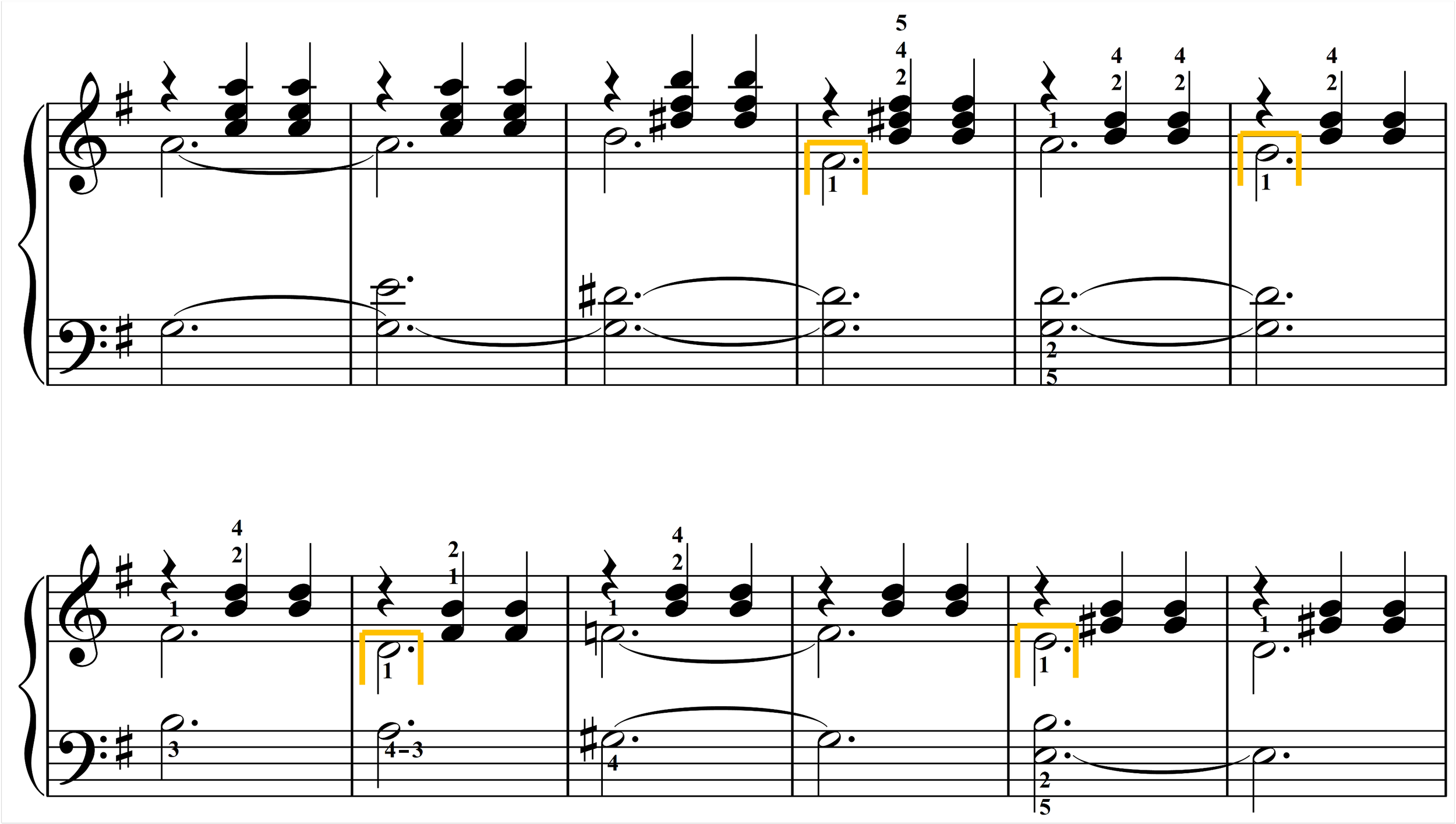
“I find that trading the melody between thumbs in this way helps improve the smoothness of the melody line.”
Submitted by Michael Clark
Published on 1/5/2024
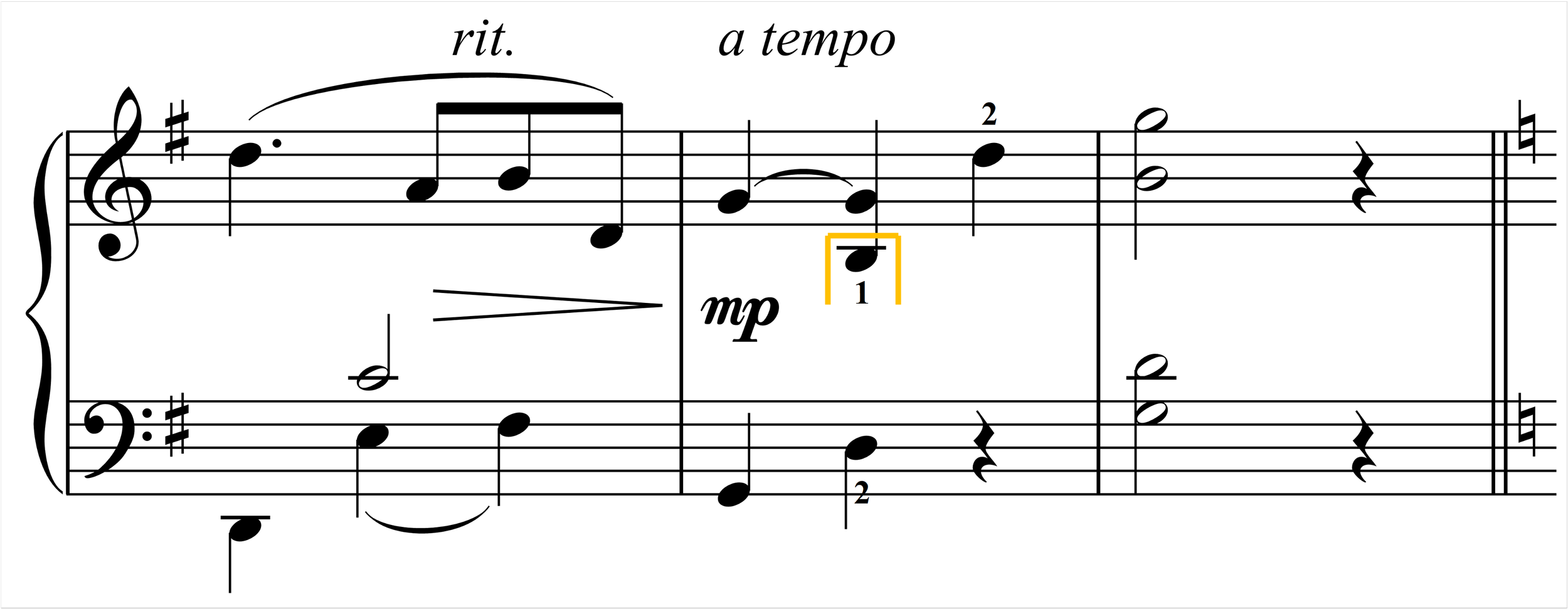
“Taking the B in the left hand allows the right hand more time to move to its next position.”
Submitted by Michael Clark
Published on 1/5/2024

“A legato fingering for the melody line results in finger 4 for the C in m. 32. Taking the middle C into the left hand naturally follows.”
Submitted by Michael Clark
Published on 1/5/2024

“I divide the chord in this way to match the position required for the next measure.”
Submitted by Michael Clark
Published on 1/5/2024

“Taking the F in the right hand helps each hand get into its new position without colliding, ensuring a secure start to the piece.”
Submitted by Michael Clark
Published on 1/3/2021

“The large leap in the left hand can be avoiding by taking the G in the right hand.”
Submitted by Michael Clark
Published on 1/3/2021

“I find the left hand passage somewhat awkward, and the brief intervention of the right hand alleviates the difficulty.”
Submitted by Michael Clark
Published on 1/3/2021

“If a ninth is comfortable for your left hand, I recommend this rearrangement which requires less shifting in the right hand.”
Submitted by Michael Clark
Published on 1/3/2021

“The right hand can easily take the F to allow the left hand more time for its position shift.”
Submitted by Michael Clark
Published on 1/3/2021

“I don’t mind start with 1 on a black key when it facilitates a consistent fingering pattern.”
Submitted by Michael Clark
Published on 1/3/2021

“This redistribution eliminates a stretch and can facilitate voicing of the alto melody.”
Submitted by Michael Clark
Published on 1/3/2021

“In such a low range, I prefer to start the grace notes as an octave. It also simplifies the groupings in the right hand.”
Submitted by Michael Clark
Published on 1/3/2021

“Taking the lower note in LH allows for the small (agate-type) notes to re-articulate precisely.”
Submitted by Sam Welsh
Published on 3/26/2020

“Hammering the upper notes with the thumb helps the student resist playing this passage legato, and keeps the hand open for the upcoming passage in ninths.”
Submitted by Sam Welsh
Published on 3/26/2020

“These simple left hand redistributions take the pressure off the right hand slightly.”
Submitted by Michael Lenahan
Published on 5/25/2020
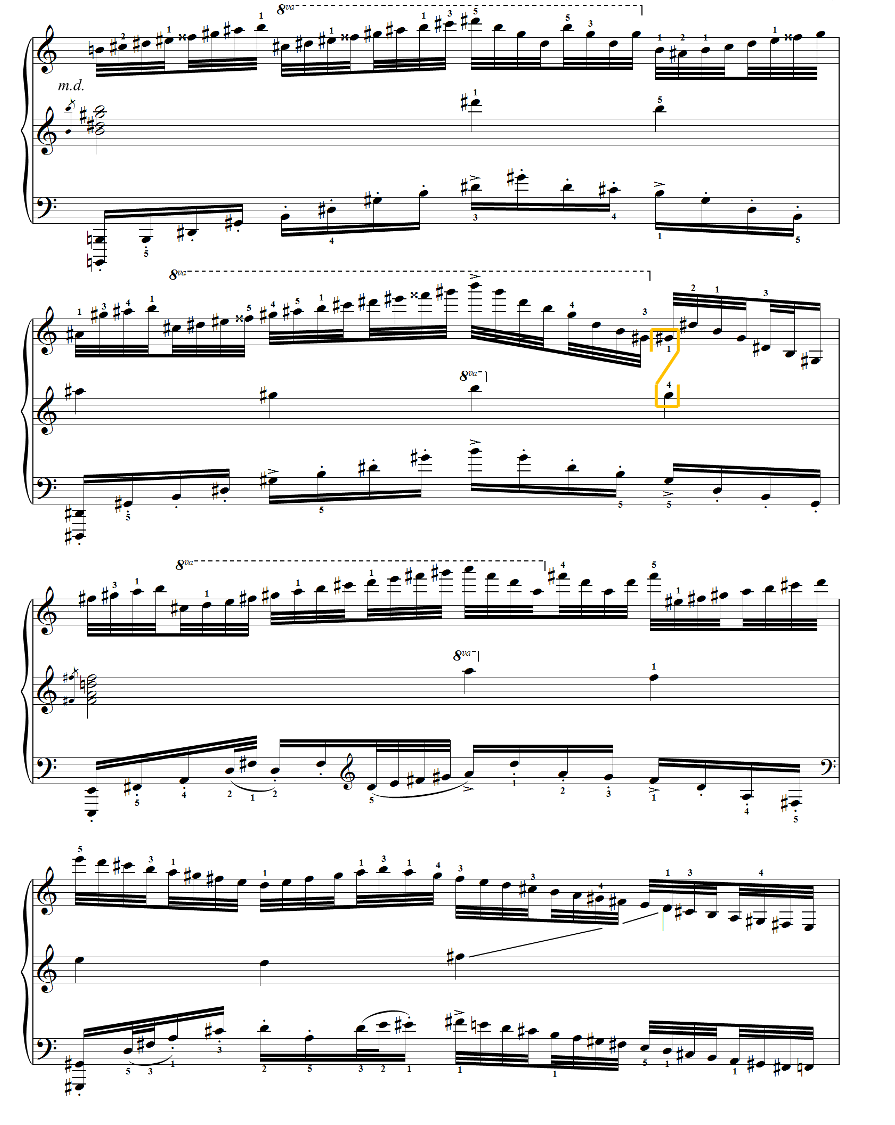
“The redistribution at the end of the 2nd measure is a lifesaver! Take the G-sharp in the top staff with the left hand as an octave, so the right just plays a repeated G-sharp with 3 and 4.”
Submitted by Michael Lenahan
Published on 5/25/2020

“The double 4s and double 5 in the LH should be played with a high wrist on the downbeat. Taking the C's with a right hand octave helps a lot.”
Submitted by Michael Lenahan
Published on 5/25/2020
Original:

Suggested performance:

“I hate playing interlocked chords with the thumbs crossing. I get rid of most of them in this section.”
Submitted by Michael Lenahan
Published on 5/25/2020