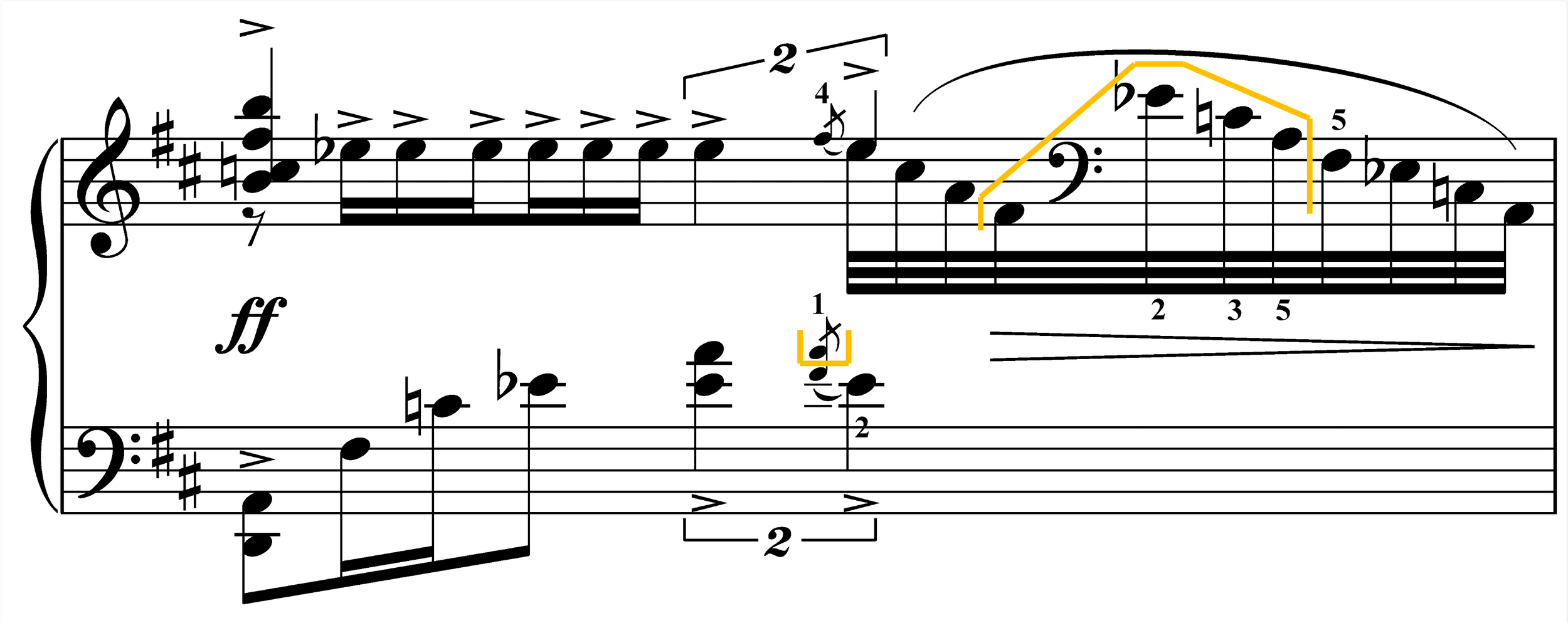
“Redistributing these grace notes as indicated above allows for a stronger left-hand fingering and sets up a serviceable hand-over-hand fingering on the descending arpeggio.”
Submitted by Michael Clark
Published on 1/10/2020


“Redistributing these grace notes as indicated above allows for a stronger left-hand fingering and sets up a serviceable hand-over-hand fingering on the descending arpeggio.”
Submitted by Michael Clark
Published on 1/10/2020
SPECIAL COLLECTION | Dorothy Brandwein’s Ravel Fingerings
Published on 4/27/2022 with the author’s permission
First appeared in Dorothy Woster Brandwein, "Divisi Fingering in Selected Passages from Ravel's Solo Piano Works" (DMA diss., University of Missouri–Kansas City, 1981), 25, 90.
25: “When sharing rapid figuration, it is essential that the notes be located close to the hand that plays them. In Example 4, the harmony is arpeggiated down three octaves between the left and right hands. The result is a brilliant fast-gliding effect—accomplished more easily by using both hands, than by using the right hand alone.”

SPECIAL COLLECTION | Dorothy Brandwein’s Ravel Fingerings
Published on 4/27/2022 with the author’s permission
First appeared in Dorothy Woster Brandwein, "Divisi Fingering in Selected Passages from Ravel's Solo Piano Works" (DMA diss., University of Missouri–Kansas City, 1981), 44, 90.
43: “There are many fortissimo passages in Ravel's keyboard music which require great strength and power.The pianist must work out fingering which gives him the most comfortable hand position and uses the strongest fingers. Example 25 cites measures in which notes can be divided so that the jumps do not diminish the tonal brilliance of the notes on the upper staff.”
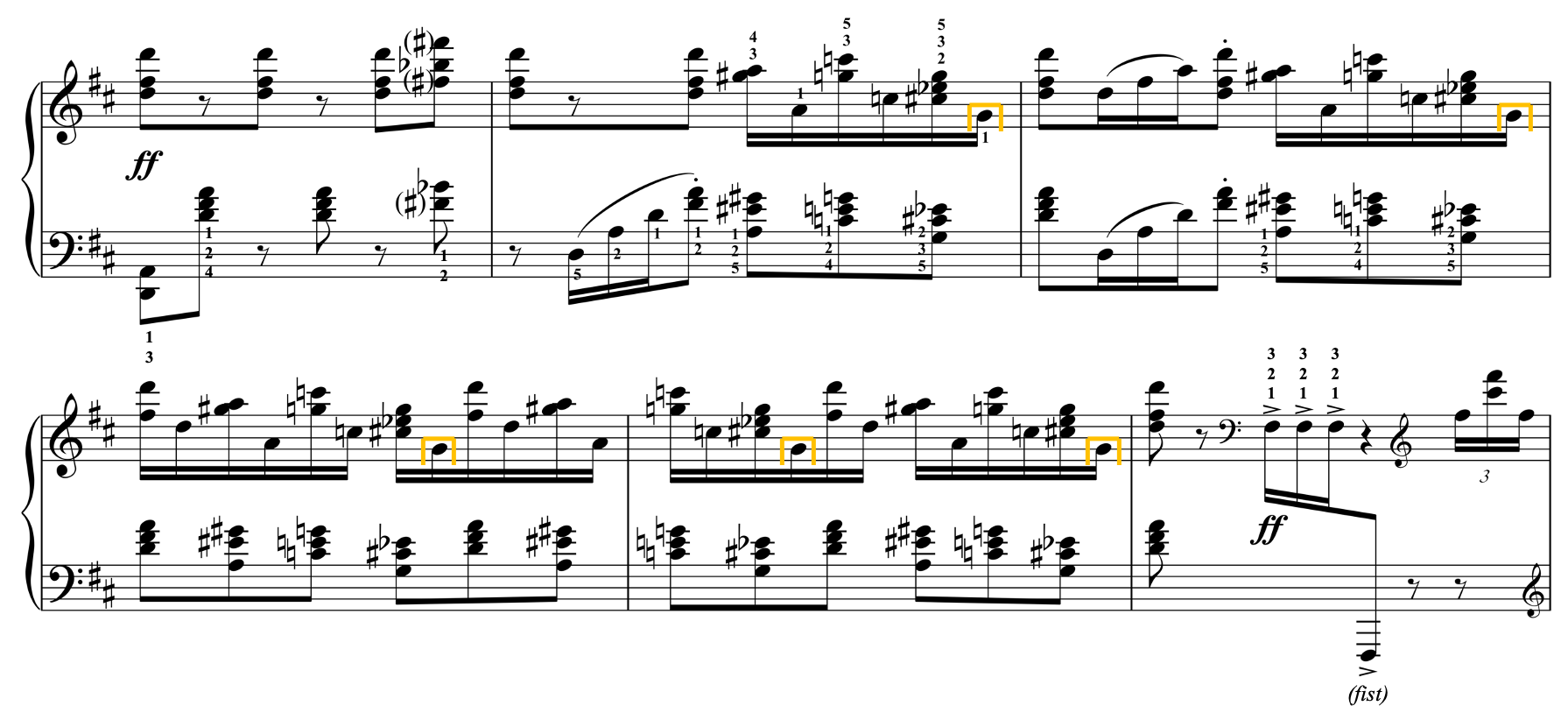
“Taking the G in the left hand eliminates a position in the right hand and allows just enough rest to facilitate the climactic speed and power required of the passage.”
Submitted by Michael Clark
Published on 1/10/2020

SPECIAL COLLECTION | Dorothy Brandwein’s Ravel Fingerings
Published on 4/27/2022 with the author’s permission
First appeared in Dorothy Woster Brandwein, "Divisi Fingering in Selected Passages from Ravel's Solo Piano Works" (DMA diss., University of Missouri–Kansas City, 1981), 59, 91.
57–58: “Dividing notes between the hands in order to attain legato fingering may enhance the pianist's musical efforts…. Other measures where an octave melody may be divided between the hands are cited in Example 43. In ‘La Vallée des cloches,’ Ravel gave some indications that the octaves are to be divided; these measures are presented in the example to clarify Ravel's markings.”

SPECIAL COLLECTION | Dorothy Brandwein’s Ravel Fingerings
Published on 4/27/2022 with the author’s permission
First appeared in Dorothy Woster Brandwein, "Divisi Fingering in Selected Passages from Ravel's Solo Piano Works" (DMA diss., University of Missouri–Kansas City, 1981), 91.
91, fn8: “The notes on the upper two staffs are indicated by Ravel to be played with the right hand. However, the edited fingering is offered in order to avoid playing the two-against-three rhythm with the same hand.”

SPECIAL COLLECTION | Dorothy Brandwein’s Ravel Fingerings
Published on 4/27/2022 with the author’s permission
First appeared in Dorothy Woster Brandwein, "Divisi Fingering in Selected Passages from Ravel's Solo Piano Works" (DMA diss., University of Missouri–Kansas City, 1981), 91.

SPECIAL COLLECTION | Dorothy Brandwein’s Ravel Fingerings
Published on 4/27/2022 with the author’s permission
First appeared in Dorothy Woster Brandwein, "Divisi Fingering in Selected Passages from Ravel's Solo Piano Works" (DMA diss., University of Missouri–Kansas City, 1981), 60, 92.
60: “Legato fingering is very useful in shaping the melodic phrases of Ravel's music. All the measures in Example 44 use divisi fingering in order that the performer may attain a better legato connection between notes.”
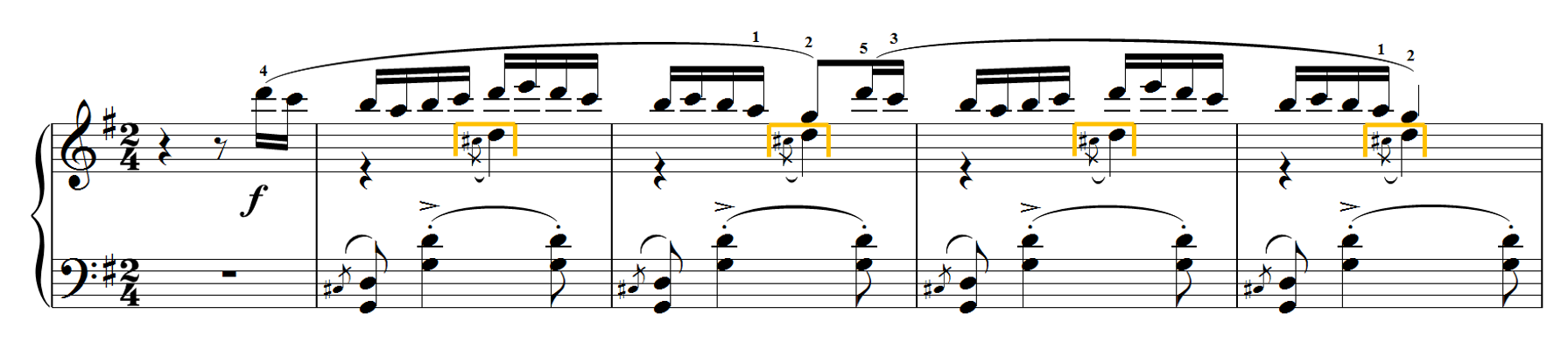
“Presumably this is was Ravel’s intended distribution, but it took me a while to figure that out as an undergraduate collaborative pianist. Hopefully seeing this will save someone some headaches!”
Submitted by Michael Clark
Published on 4/13/2020
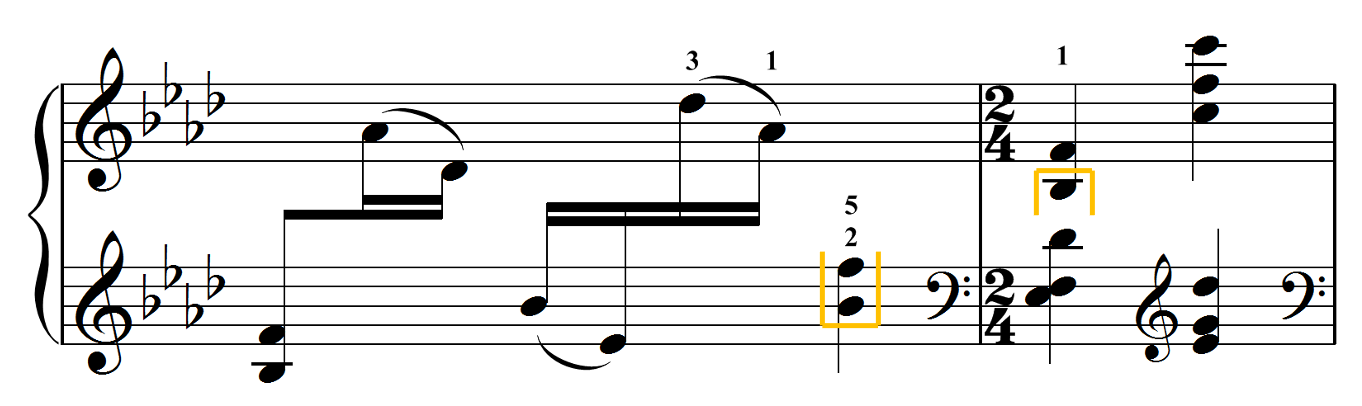
“At the rapid tempo of this song, I can do without this particular hand crossing. This fingering also reduces position shifts in the right hand and uncrosses the distribution of the inner notes .”
Submitted by Michael Clark
Published on 4/13/2020

“I prefer these E-flats in the right hand so that I can prepare better for the position of the following measure.”
Submitted by Michael Clark
Published on 4/13/2020
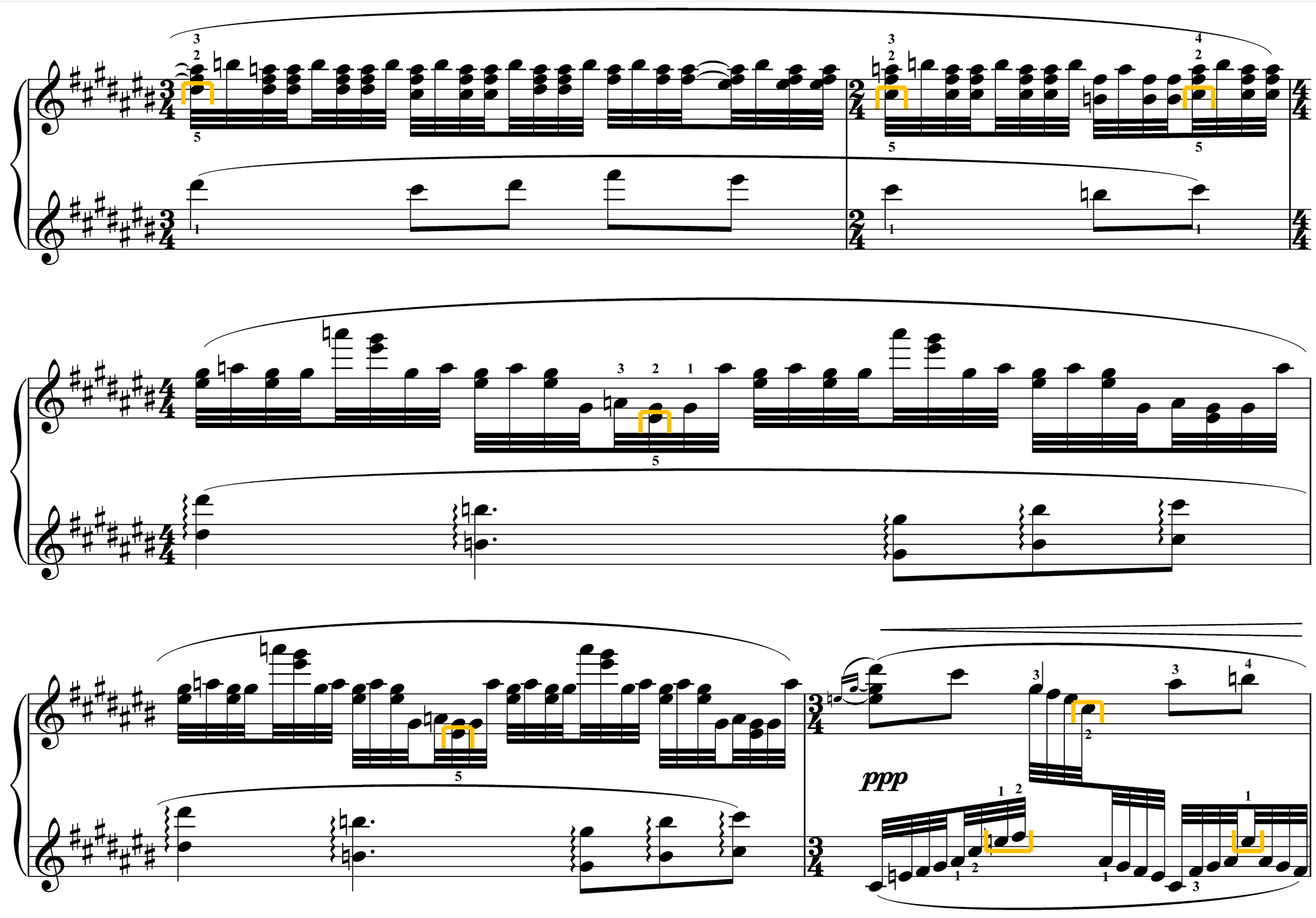
SPECIAL COLLECTION | Dorothy Brandwein’s Ravel Fingerings
Published on 4/4/2022 with the author’s permission
First appeared in Dorothy Woster Brandwein, "Divisi Fingering in Selected Passages from Ravel's Solo Piano Works" (DMA diss., University of Missouri–Kansas City, 1981), 26, 29, 93.
26–27: “Constant thirty-second note figurations provide an undercurrent of sound throughout ‘Ondine.’ Measures like those in Example 6 can be played smoothly and with less effort when the notes are taken by the hand closest to them… The above measures, as well as those in Example 7, illustrate a consistency in the note patterns and their fingerings.”
29: “A recurring harmonic figuration in "Ondine" which encompasses two or three octaves presents an extreme problem for the right hand [mm. 15–16]. The difficulty is the rapid shift of the thumb required at the bottom of the pattern which propels the hand back up to the top. These shifts can nearly always be avoided by playing the lowest note of the pattern with the left hand.”
93, fn10: "The pianist must be careful that this divisi fingering does not interrupt the flow of the melody on the lower staff [mm.13–14]."

SPECIAL COLLECTION | Dorothy Brandwein’s Ravel Fingerings
Published on 4/28/2022 with the author’s permission
First appeared in Dorothy Woster Brandwein, "Divisi Fingering in Selected Passages from Ravel's Solo Piano Works" (DMA diss., University of Missouri–Kansas City, 1981), 27, 94.
26–27: “Constant thirty-second note figurations provide an undercurrent of sound throughout ‘Ondine.’ Measures like those in Example 6 can be played smoothly and with less effort when the notes are taken by the hand closest to them… The above measures, as well as those in Example 7, illustrate a consistency in the note patterns and their fingerings.”

SPECIAL COLLECTION | Dorothy Brandwein’s Ravel Fingerings
Published on 4/28/2022 with the author’s permission
First appeared in Dorothy Woster Brandwein, "Divisi Fingering in Selected Passages from Ravel's Solo Piano Works" (DMA diss., University of Missouri–Kansas City, 1981), 94.

SPECIAL COLLECTION | Dorothy Brandwein’s Ravel Fingerings
Published on 4/28/2022 with the author’s permission
First appeared in Dorothy Woster Brandwein, "Divisi Fingering in Selected Passages from Ravel's Solo Piano Works" (DMA diss., University of Missouri–Kansas City, 1981), 54, 94.
54: “The rolled chords in Example 38 must all be played quickly so they do not disturb either the rhythmic pulse or the phrasing. In each case, divisi fingering eliminates the wide stretch required of one hand. Example 38 illustrates how the notes in each rolled chord may be shared by both hands. The notes of the rolled chords in "Ondine" are especially easy to blend at a soft dynamic level….”

SPECIAL COLLECTION | Dorothy Brandwein’s Ravel Fingerings
Published on 4/28/2022 with the author’s permission
First appeared in Dorothy Woster Brandwein, "Divisi Fingering in Selected Passages from Ravel's Solo Piano Works" (DMA diss., University of Missouri–Kansas City, 1981), 94.

SPECIAL COLLECTION | Dorothy Brandwein’s Ravel Fingerings
Published on 4/28/2022 with the author’s permission
First appeared in Dorothy Woster Brandwein, "Divisi Fingering in Selected Passages from Ravel's Solo Piano Works" (DMA diss., University of Missouri–Kansas City, 1981), 95.

SPECIAL COLLECTION | Dorothy Brandwein’s Ravel Fingerings
Published on 4/28/2022 with the author’s permission
First appeared in Dorothy Woster Brandwein, "Divisi Fingering in Selected Passages from Ravel's Solo Piano Works" (DMA diss., University of Missouri–Kansas City, 1981), 95.