Submitted by Melinda Smashey Jones
Published on 12/29/2020


Submitted by Melinda Smashey Jones
Published on 12/29/2020

Submitted by Melinda Smashey Jones
Published on 12/29/2020

Submitted by Melinda Smashey Jones
Published on 12/29/2020

Submitted by Melinda Smashey Jones
Published on 12/29/2020

Submitted by Melinda Smashey Jones
Published on 12/29/2020

“I play the left-hand F-sharp before the beat. The four treble notes sound better struck as a solid chord than rolled, and I am less bothered by the bass F-sharp being early.”
Submitted by Melinda Smashey Jones
Published on 12/29/2020

Submitted by Melinda Smashey Jones
Published on 12/29/2020

Submitted by Melinda Smashey Jones
Published on 12/29/2020

Submitted by Melinda Smashey Jones
Published on 12/29/2020


Submitted by Melinda Smashey Jones
Published on 12/29/2020

Submitted by Melinda Smashey Jones
Published on 12/29/2020
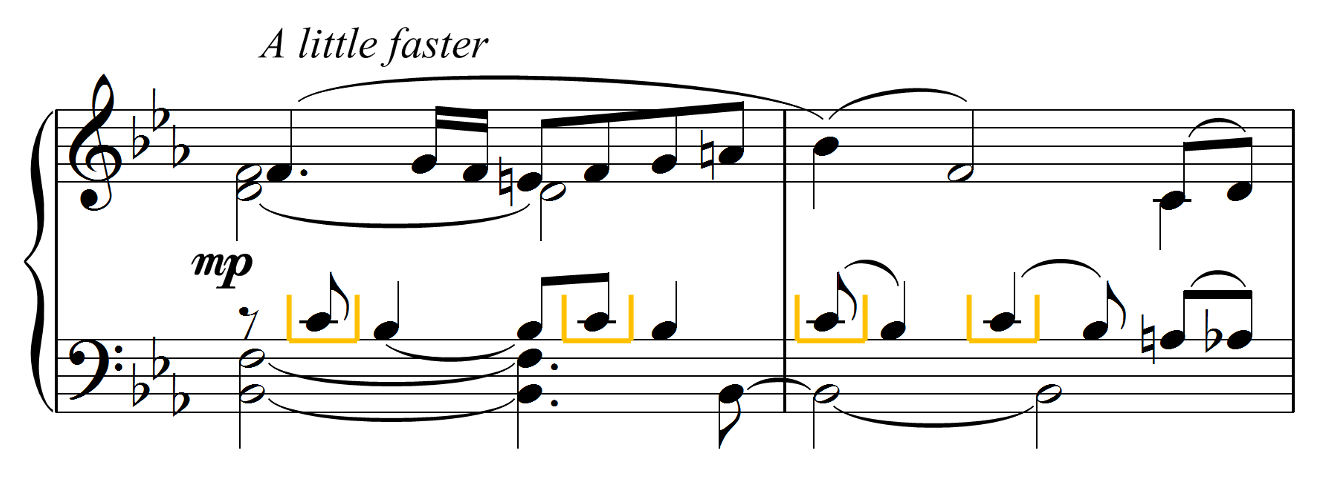
Submitted by Melinda Smashey Jones
Published on 12/29/2020

Submitted by Melinda Smashey Jones
Published on 12/29/2020


Submitted by Melinda Smashey Jones
Published on 12/29/2020

“Splitting the melody between the hands helps the right hand stay in the position necessary to play the thirty-second note line.”
Submitted by Michael Clark
Published on 3/15/2020

“These quick sixths are more reliably and smoothly played with two hands.”
Submitted by Michael Clark
Published on 3/15/2020

“This wide left-hand accompaniment reaches up into the right-hand register, allowing several notes to be more comfortably taken by the right hand.”
Submitted by Michael Clark
Published on 3/15/2020

“Though it’s not obvious on first glance, these notes are within the reach of the right hand.”
Submitted by Michael Clark
Published on 3/15/2020