Submitted by Ben Pawlak
Published on 3/29/2020


Submitted by Ben Pawlak
Published on 3/29/2020

“I alternate fingers 4 and 3 in the second measure to prevent kinetic confusion.”
Submitted by Seolyeong Jeong
Published on 8/23/2021

“I start every left-hand fingering group with 1 to prevent confusion.”
Submitted by Seolyeong Jeong
Published on 8/23/2021

“The unusual two-over-thumb (thumb on a black key) secures the upper third (a, c#), especially for people without very large hands or with a short pinky.”
Submitted by Jörg Winter
Published on April 27, 2023

“Playing as written makes the hands crowded. This distribution prevents that.”
Submitted by Michael Lenahan
Published on 6/7/2020

“The fingering Rachmaninoff gives requires tricky double thumbs in the right hand. I find it easier to take those notes in the left hand creating a repeated note in the left hand. The fingering in last measure of this passage removes the awkward ninths in each hand.”
Submitted by Michael Lenahan
Published on 5/25/2020
Fingerings in Italics are Rachmaninoff’s.

“I chose these fingerings to correspond to the musical phrase/accents.”
Submitted by Seolyeong Jeong
Published on 8/23/2021
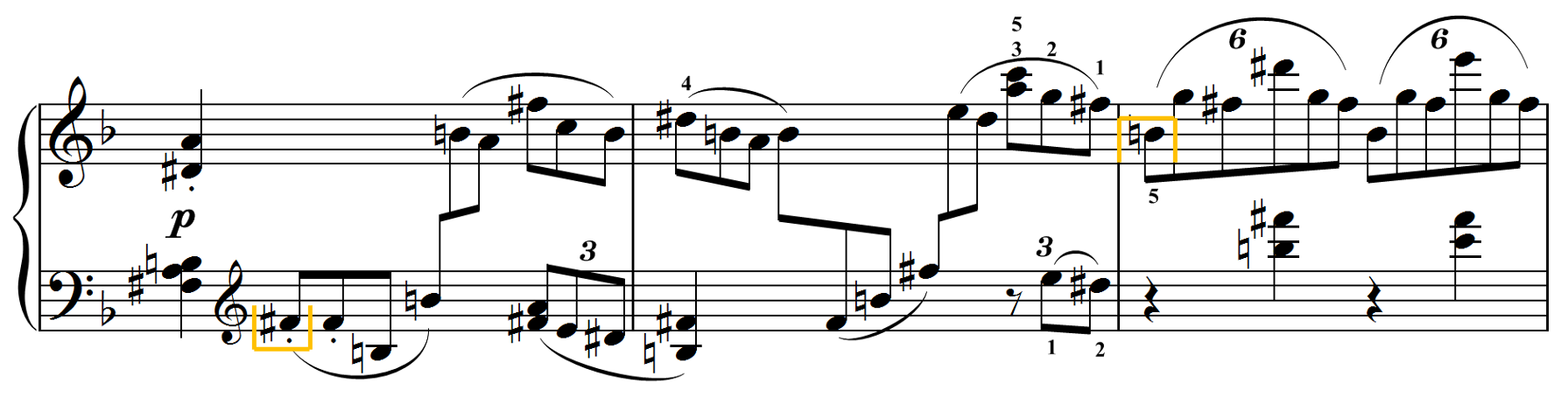
“The first redistribution simplifies a repeated note; the second one alleviates an awkward stretch in the right hand.”
Submitted by Michael Lenahan
Published on 5/25/2020

“While what Rachmaninoff wrote isn't particularly difficult, I find playing alternating thirds between the hands is more effortless and it comes out more articulate. It's a good way to get this nasty section off on the right foot.”
Submitted by Michael Lenahan
Published on 5/25/2020

“By taking the B and the A with the thumb in the left hand, this makes the right hand simpler.”
Submitted by Michael Lenahan
Published on 5/25/2020

Submitted by Seolyeong Jeong
Published on 8/23/2021
“I repeat the fingering of 3/1 to let the top of the chord in the second measure be played with 5. I rearrange the hands in the second measure for the sake of bringing out the melody.”
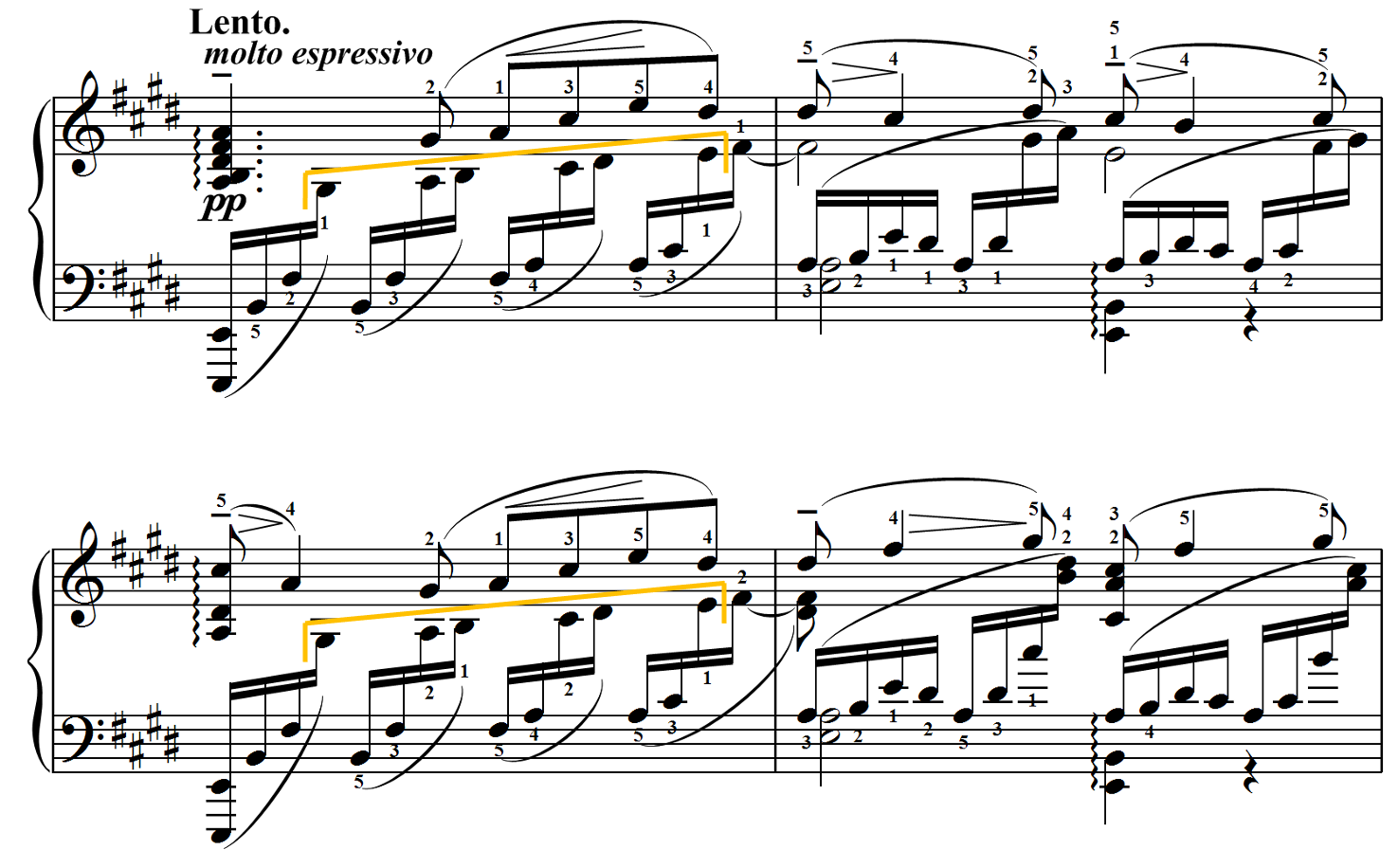
“By keeping most of the 16th notes in the left hand, the right hand is simplified so you will be free to focus on legato and phrasing.”
Submitted by Michael Lenahan
Published 5/25/2020

“By keeping most of the 16th notes in the left hand, the right hand is simplified so you will be free to focus on legato and phrasing.”
Submitted by Michael Lenahan
Published on 5/25/2020

Submitted by Michael Lenahan
Published on 5/25/2020

Submitted by Perry Zhou
Published on 5/20/2025
“The voicing of the middle line towards the end of this Etude proves to be more effective with hand redistribution (and relieves the left hand from all those distances.) Particularly between the 4th and 5th eighth notes of m. 57 where the R.H. is able to hold the A to connect to the G (LH) keeping the line.”

Submitted by Perry Zhou
Published on 5/25/2025
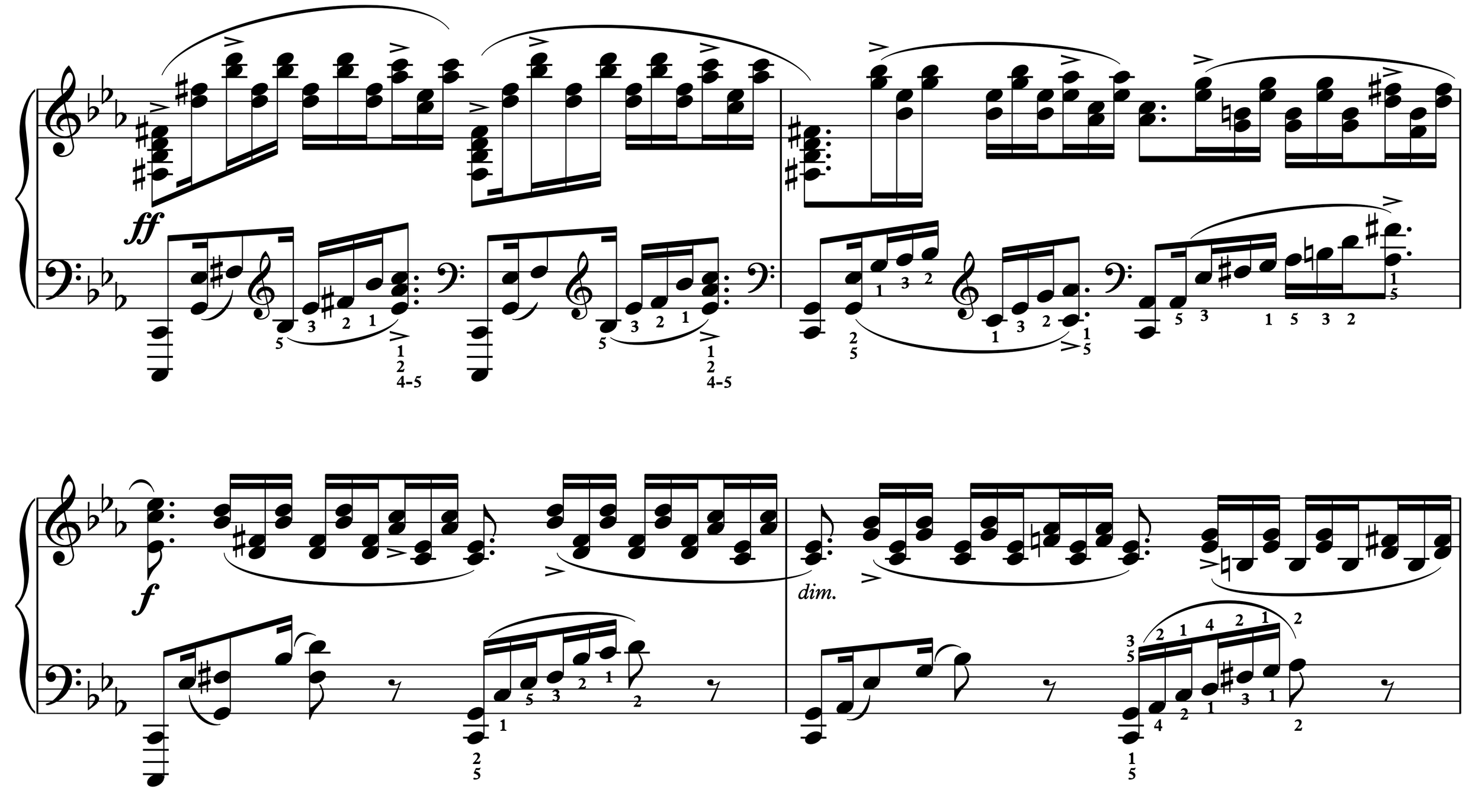
“This was one of the pesky sections of the final etude of Op. 33; here are my ideal fingerings. Notice in the first beat unlike the right hand, which utilizes the distance between the 1st and 2nd fingers for easier grouping (5-4-3-2), the LH has to make do with (1-2-3-1) since the 4th and 5th fingers don’t have the distance.”

Submitted by Brian Marks
Published on 3/8/2023