“This leap is easier as just a tenth with the left hand taking the E-flat.”
Submitted by Michael Clark
Published on 3/16/2020


“This leap is easier as just a tenth with the left hand taking the E-flat.”
Submitted by Michael Clark
Published on 3/16/2020

“Taking the F in the right hand allows the bass to sustain while I pedal with the right-hand line.”
Submitted by Michael Clark
Published on 3/16/2020

“The top notes of some of the large chords in the left hand are within reach of the right-hand thumb, eliminating the needs for rolls on those chords.”
Submitted by Michael Clark
Published on 3/16/2020

“The right-hand thumb is already playing E-sharp, so there’s no need to stretch with the left hand or let go of the bass notes. With this fingering, I can change the pedal on the final chord without losing the bass.”
Submitted by Michael Clark
Published on 3/16/2020

“The use of the thumb for the seconds in the right-hand makes this passage easy to ‘throw off.’ As an added bonus, using the thumb (rather than 1-2) for the dyad keeps my hand in an open position (rather than a contracted position), which makes the passagework in m. 69 feel more comfortable.”
Submitted by Sarah Rushing
Published on 3/8/2023

“There are a few different possibilities here. This is a -no-fuss’ option that keeps my hands in single, easy-to-find positions.”
Submitted by Sarah Rushing
Published on 3/8/2023

Submitted by Kate Acone
Published on 1/8/2020
Original:

Suggested performance:

“I find it easier to uncross the notes that overlap between the hands.”
Submitted by Michael Clark
Published on 1/1/2020

“I find that taking the F-double sharp in the right hand is more reliable. My left hand can make the leap to D-sharp more accurately without worrying about getting to a white key after.”
Submitted by Michael Clark with thanks to Robert Roux
Published on 1/1/2020

“Using this fingering on the ascending arpeggio in the right hand leads smoothly into the octaves. On the descent, I prefer to start with an octave in the right hand so that the left hand can start with 1 on D.”
Submitted by Michael Clark
Published on 1/1/2020

“Taking the top note of the first few sixths in the right hand eliminates the large leap in the left hand. This redistribution feels much more secure to me.”
Submitted by Michael Clark
Published on 1/1/2020

“Starting with two hands helps me get this challenging movement off on the right foot. Taking the low F-sharp in m. 10 in the left hand gives more fingering flexibility for the repeated notes.”
Submitted by Michael Clark with thanks to Robert Roux
Published on 1/1/2020
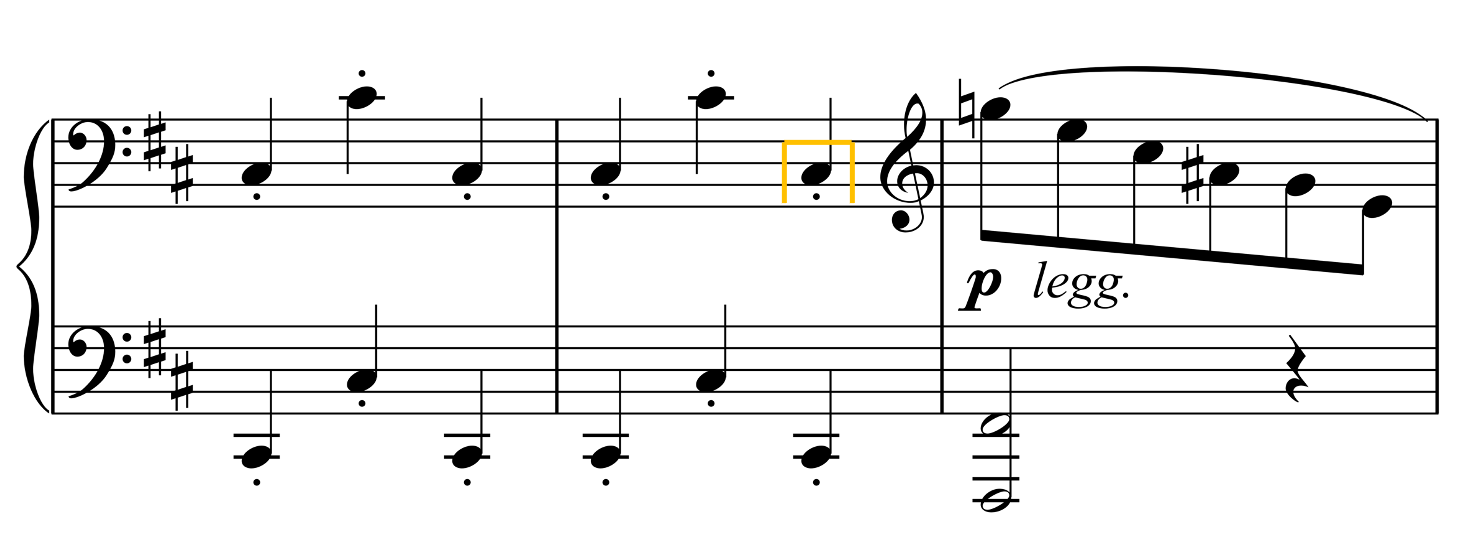
“Taking the final C-sharp as an octave in the left hand gives the right hand extra time to move to the next position.”
Submitted by Michael Clark
Published on 1/3/2022

“The pedal is all the way down on this sudden fortissimo. There’s no reason not to get both hands involved.”
Submitted by Michael Clark
Published on 1/1/2020

“Taking the final G-sharps as an octave lets the left hand prepare for the next measure slightly earlier. Every little moment helps, and it’s easier to stagger the position shifts in the left and right hands.”
Submitted by Michael Clark
Published on 1/1/2020

“Ending the eighth-note run on finger 1 brings the right hand closer to the next position.”
Submitted by Michael Clark
Published on 1/3/2022

“I find this fingering more reliable and easier to control at this very soft dynamic and fast tempo.”
Submitted by Michael Clark
Published on 1/1/2020

“This fingering prioritizes a secure arrival on the final chord by placing 1 on the G two sixteenths earlier.”
Submitted by Michael Clark
Published on 1/3/2022