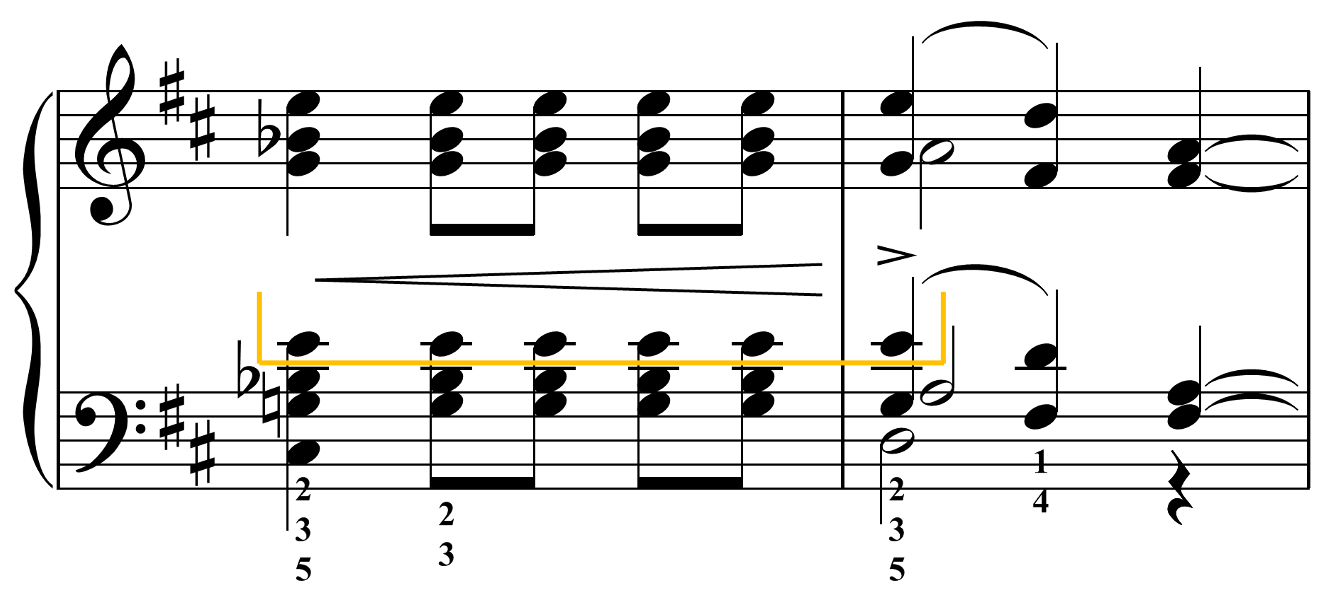
“If the stretch is uncomfortable in the right hand, the bottom line of the treble staff can be taken in the left hand.”
Submitted by Michael Clark
Published on 1/1/2020


“If the stretch is uncomfortable in the right hand, the bottom line of the treble staff can be taken in the left hand.”
Submitted by Michael Clark
Published on 1/1/2020

“I have greater control over the voicing with this fingering.”
Submitted by Michael Clark with thanks to Nancy Weems
Published on 1/1/2020

“This redistribution is the feasible way to play this passage for most hand sizes.”
Submitted by Michael Clark
Published on 1/1/2020

“This redistribution requires few position shifts.”
Submitted by Michael Clark with thanks to Nancy Weems
Published on 1/1/2020

“Starting the scale with a left-hand octave is more secure.”
Submitted by Michael Clark
Published on 1/1/2020

“Transferring the scale to the right hand a little early allows the left hand to prepare for the chord.”
Submitted by Michael Clark
Published on 8/4/2021

“I find this distribution mentally more secure because my left-hand thumb consistently returns to D.”
Submitted by Michael Clark
Published on 1/1/2020

Submitted by Michael Lenahan
Published on 5/1/2020

Submitted by Michael Lenahan
Published on 5/1/2020

Submitted by Michael Lenahan
Published on 5/1/2020
Submitted by Michael Lenahan
Published on 5/1/2020

Submitted by Michael Lenahan
Published on 5/1/2020

Submitted by Michael Lenahan
Published on 5/1/2020

Submitted by Michael Lenahan
Published on 5/1/2020

Submitted by Michael Lenahan
Published on 5/1/2020
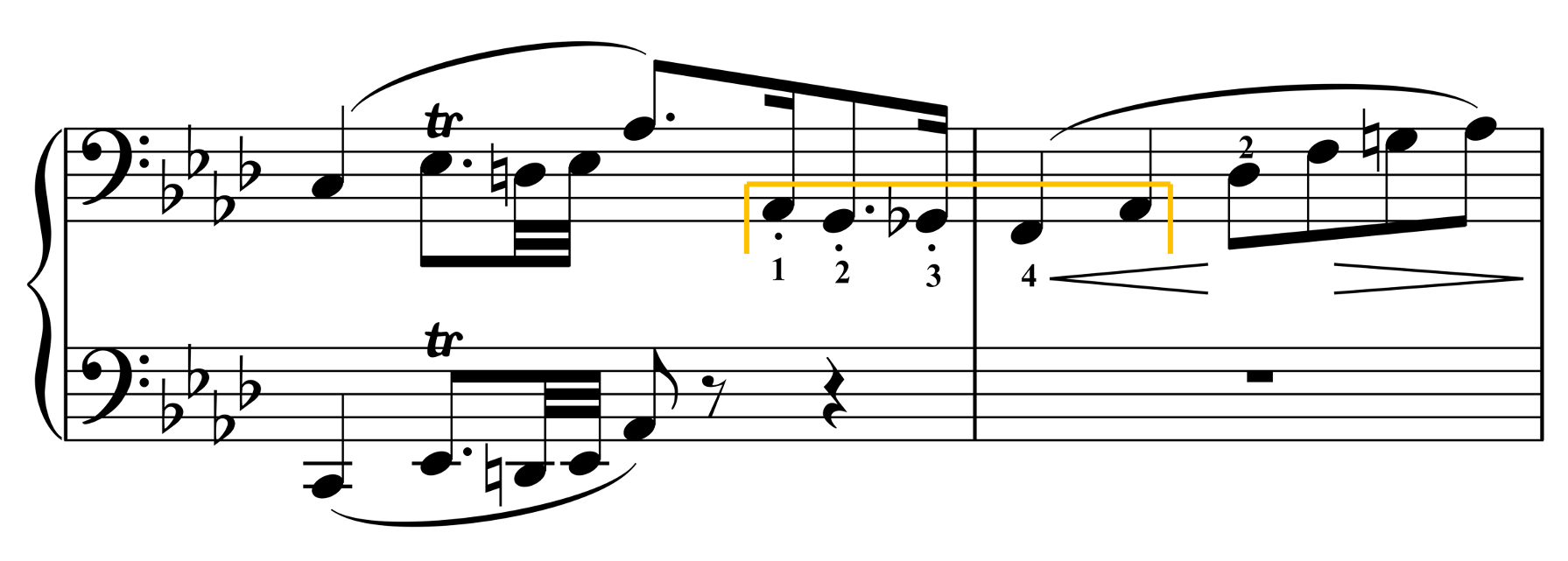
“The left hand is already in this register, and using two hands avoids a position shift in the right hand.”
Submitted by Michael Clark
Published on 1/1/2020

“The left hand can assist in a secure ending to the trill.”
Submitted by Michael Clark
Published on 1/1/2020
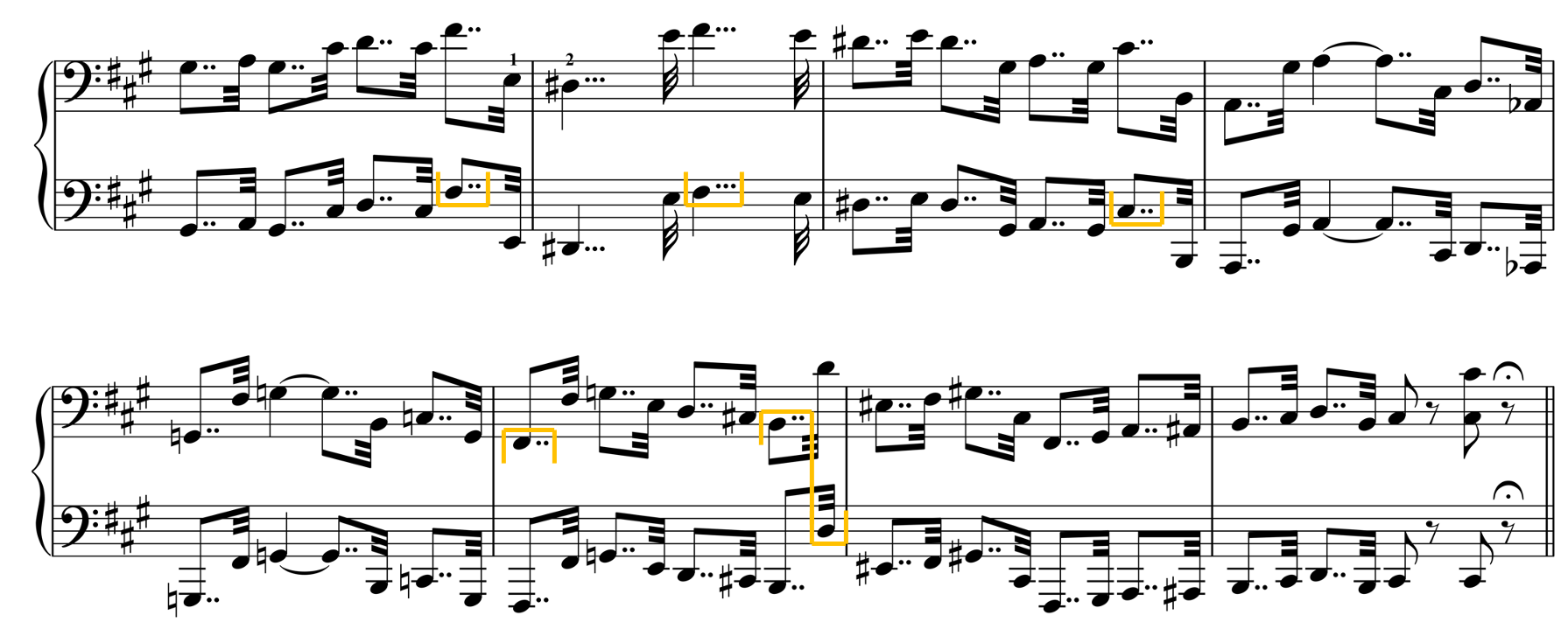
“Take some of the highest and lowest notes as octaves reduces the number of position shifts.”
Submitted by Michael Clark
Published on 1/1/2020