“It's very hard to play the left hand the way Schumann wrote it, especially to keep the staccato notes crisp. This solution simplifies it.”
Submitted by Michael Lenahan
Published on 12/16/2022


“It's very hard to play the left hand the way Schumann wrote it, especially to keep the staccato notes crisp. This solution simplifies it.”
Submitted by Michael Lenahan
Published on 12/16/2022

“This figuration repeats many times, and each time I redistribute it this way. It makes the voicing and repeated notes so much easier.”
Submitted by Michael Lenahan
Published on 12/16/2022

“It's obviously much easier to leave out the redundant right-hand notes. I let the left hand do all the work which lets the right hand focus on phrasing and voicing.”
Submitted by Michael Lenahan
Published on 12/16/2022

“This redistribution keeps the left hand from moving around too much.”
Submitted by Michael Lenahan
Published on 12/16/2022

“I always avoid overlapping thumbs!”
Submitted by Michael Lenahan
Published on 12/16/2022

“I don't like Schumann's fingering here! I take some of the running 8th notes with my left hand, but I find it much more smooth to take a lot of them with the right hand.”
Submitted by Michael Lenahan
Published on 12/16/2022
“This fingering helps prioritize the smooth line without an over-reliance on pedal that might muddy the texture and overcast the great counterpoint in the inner voices.”
Submitted by Wade Troyer
Published on 9/27/2022


“This fingering helps prioritize the smooth line without an over-reliance on pedal that might muddy the texture and overcast the great counterpoint in the inner voices.”
Submitted by Wade Troyer
Published on 9/27/2022
Original:

Suggested performance:

“Dividing the thirds between the hands is more comfortable and more legato.”
Submitted by Michael Clark
Published on 1/1/2020
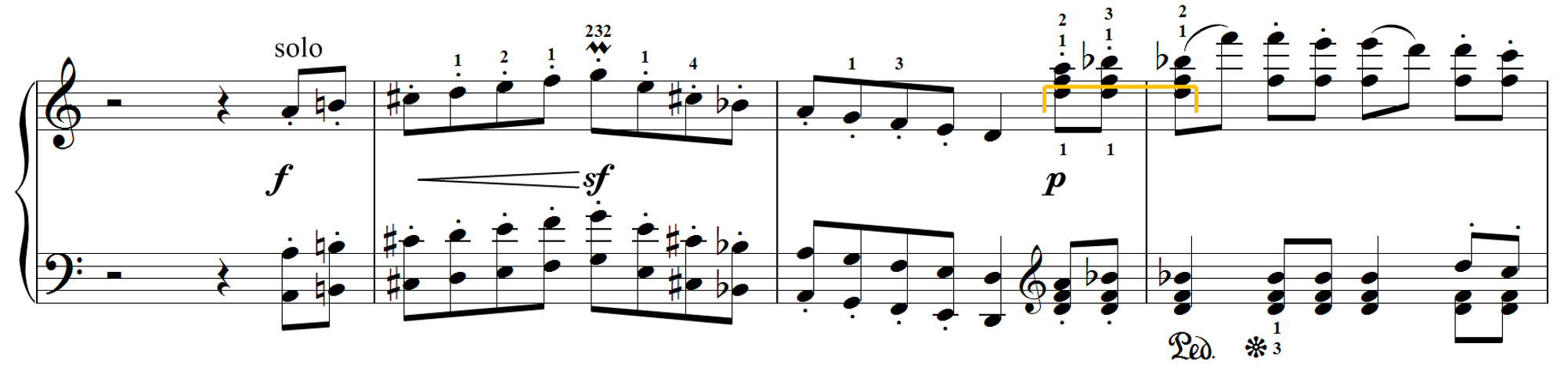
“Shifting the D5s to the left hand helps with voicing and keeps the right hand in a more compact position.”
Submitted by Michael Clark
Published on 4/18/2020

“This division of the notes eliminates several finger crossings and adds security and visual flourish to the descending arpeggio.”
Submitted by Michael Clark
Published on 4/18/2020

“I find taking these extra notes in the right hand more reliable than playing the left hand as written.”
Submitted by Michael Clark with thanks to Robert Roux
Published on 4/18/2020

“I like to shift the right hand early to ensure strong melodic delivery.”
Submitted by Michael Clark
Published on 1/1/2020

“Splitting the tenor line between the thumbs ensures it is well projected and eliminates potential rolls or stretches in the left hand.”
Submitted by Michael Clark
Published on 1/1/2020

“The orchestra plays the melody in this phrase so I choose to bring out the bass line. Taking more notes in the right hand allows me to play the bass line with greater projection and improved legato.”
Submitted by Michael Clark
Published on 8/5/2021

“The A-flat falls comfortably in the right hand.”
Submitted by Michael Clark
Published on 1/1/2020

“I prefer to take the F as a left hand octave for a more secure arrival on the right-hand chord.”
Submitted by Michael Clark
Published on 1/1/2020

“I prefer taking an extra note in the left hand to ensure melodic accuracy.”
Submitted by Michael Clark
Published on 1/1/2020