“Taking the final triplet before the leap in the right hand makes the leap more secure.”
Submitted by Michael Clark
Published on 4/18/2020

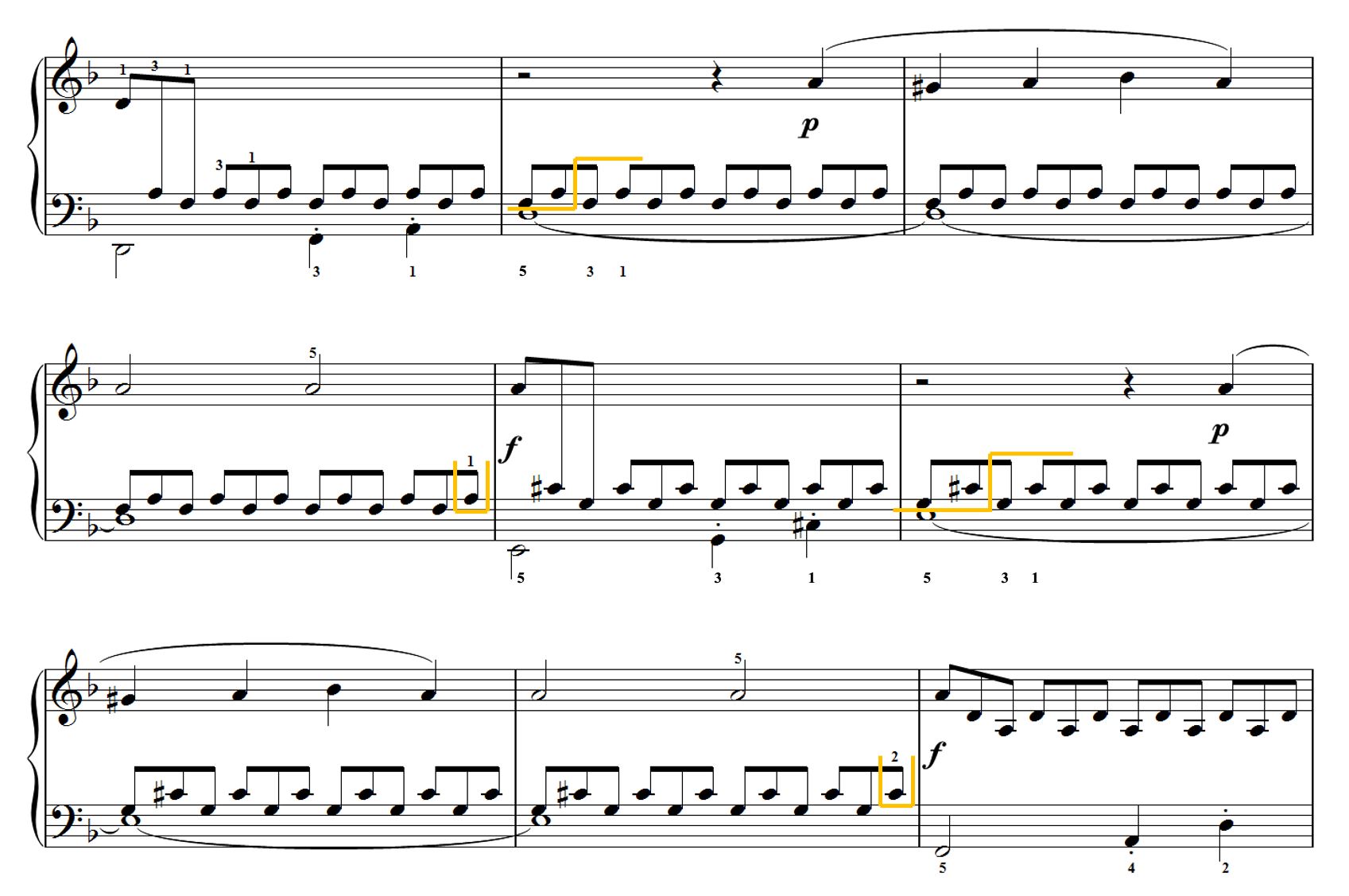
“Taking the final triplet before the leap in the right hand makes the leap more secure.”
Submitted by Michael Clark
Published on 4/18/2020
RH in red, LH in blue

“When the bass is a whole note, hold the pedal for four beats so the bass sustains while the left hand crosses over the right. This redistribution feels more secure to me than the awkward leap involved in trading the triplets between the hands.”
Submitted by Michael Clark with thanks to Robert Roux
Published on 4/18/2020

“The stretch of a seventh between 5 and 2 in the left hand is awkward and unreliable. Taking the the D-sharp with the right-hand thumb facilitates a more secure performance of the left-hand line.”
Submitted by Michael Clark
Published on 4/18/2020

“The leap down to the B-flat is treacherous, and it can be difficult to play it with satisfactory power. Taking it in the right hand eliminates the leap and assures a strong delivery.”
Submitted by Michael Clark with thanks to Robert Roux
Published on 4/18/2020

“Transferring the E-flat and G-flat silently into the left hand frees the right hand for a more melodic performance of the turn with stronger fingers.”
Submitted by Michael Clark
Published on 4/18/2020

“My voicing of the melodic line improves when I play the top F alone and play the bottom F in the left hand.”
Submitted by Michael Clark
Published on 4/18/2020

“With the left hand's help, legato in all voices is possible.”
Submitted by Michael Clark
Published on 4/18/2020

“Both hands have to leap, but I find it easier for them to shift only once instead of twice right in a row. This redistribution keeps everything up to the forte in one position.”
Submitted by Michael Clark
Published on 4/18/2020

“Taking the D in the left hand allows for maximum security and power at this climactic moment.”
Submitted by Michael Clark with thanks to Robert Roux
Published on 4/18/2020